
Blood Sugar Balancing
Chinese Medicine for Blood Sugar Imbalances
Chinese medicine address blood sugar imbalances by addressing individual constitutional imbalances to eliminate blood sugar imbalances and possibly reduce the risk of developing more serious conditions requiring medication. You can choose to use a variety of self-care techniques to promote wellness including acupressure, Chinese herbal medicine, and lifestyle/dietary methods. Addressing blood sugar issues naturally requires the regulation and circulation of Blood and Qi that help to balance the organ systems and improve pancreatic function and resolve internal heat that deplete bodily fluids. For best outcomes using self-care, apply associated Aroma Acu-Sticks® to acu-points, use topical remedies, and follow good lifestyle practices.

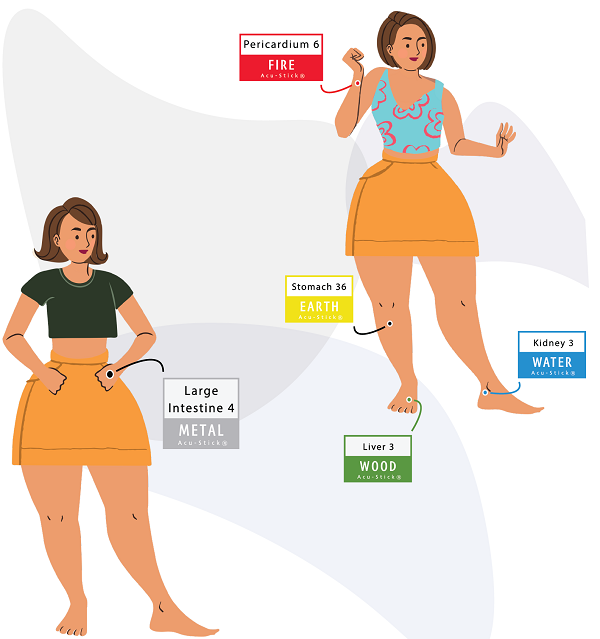
Aroma Acu-therapy™ for Blood Sugar Balance

Kidney 3
Apply the Water Element Aroma Acu-Stick® to activate Acupressure Point KI 3
Why? Acu-point Kidney 3 is the Source Point of the Kidney energetic organ system that is used to tonify Yin throughout the body according to Traditional Chinese Medicine.
 Stomach 36
Apply the Earth Element Aroma Acu-Stick® to activate Acupressure Point ST 36
Why? Acu-point Stomach 36 is the main Qi energy bolstering point if the body that also dispels Stomach Heat.
 Large Intestine 4
Apply the Metal Element Aroma Acu-Stick® to activate Acupuncture Point LI 4
Why? LI 4 works together with Liver 3 to invigorate the circulation of Blood and Qi and is referred to as the "Four Gates".
 Liver 3
Apply the Wood Element Aroma Acu-Stick® to activate Acupressure Point LV 3
Why? The Liver circulates Qi energy and acu-point Liver 3 is the energy source point for the Liver energetic organ system and promotes circulation generally.
 Pericardium 6
Apply the Fire Element Aroma Acu-Stick® to activate Acupuncture Point Pericardium 6
Why? Acu-point PER 6 activates the Linking Vessel, supports Yin of the body, and is influential over digestion and the Spleen. It is known for its ability to pacify nausea.
Related Articles:
Blood Sugar Imbalances in Chinese Medicine According to Symptoms
It is not uncommon for blood sugar imbalances to present with more than one of these patterns of imbalance since it is a chronic condition that likely affects multiple energetic organ systems.
Spleen Qi Deficiency and the Pancreas
In Chinese medicine, the pancreas is part of the Spleen energetic organ system Symptoms of Spleen Qi Deficiency may include loose stools, low energy, distention and gas after meals, weak limbs, scallops on the side of the tongue, and sometimes a loss of appetite. Spleen Qi Deficiency is also indicated in cases of insulin resistance and hypoglycemia which are often considered pre-diabetic conditions.
Spleen imbalance are implicated when dealing with any type of blood sugar imbalances. This often develops in to Internal Dampness that causes weight gain, fatigue, heavy feeling limbs, and/or pain throughout the body.
Acupressure Point Combination Strategy:
- Apply the Earth Element Acupressure Stick to Acupressure Point Stomach 40
- Apply the Earth Element Acupressure Stick to Acupressure Point Spleen 3
- Apply the Earth Element Acupressure Stick to Acupressure Point Spleen 4
- Apply the Earth Element Acupressure Stick to Acupressure Point Spleen 9
- Apply the Fire Element Acupressure Stick to Acupressure Point Pericardium 6
Kidney Yin Deficiency And Blood Sugar Issues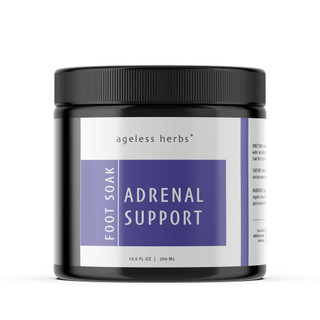
Yin Deficiency would generally include thirst, dry mouth, frequent urination of dark urine, and soreness in the lower back and knees. This was historically a common early indication of sugar imbalances, but modern day manifestations tend to have more Spleen Qi imbalances at first. As the body works to purge the insidious pathogenic Dampness due to a damaged Spleen energetic system, the Yin is consumed.
Yin represents substance in the body, and compromising Yin leads to premature aging. As the disease progresses the Yin substance consumed can include the myelin sheath of the nerves leading to neuropathy.
Acupressure Point Combination Strategy:
- Apply the Water Element Acupressure Stick to Acupressure Point Kidney 3
- Apply the Water Element Acupressure Stick to Acupressure Point Kidney 7
- Apply the Earth Element Acupressure Stick to Acupressure Point Spleen 4
- Apply the Earth Element Acupressure Stick to Acupressure Point Spleen 6
Stomach Heat
Closely associated with Yin Deficiency, Stomach Heat can develop due to Stomach Yin Deficiency possibly created by poor diet. Signs would include thirst, a big appetite, and yellow coated tongue. The temptation is to drink iced drinks to cool the heat and quench the thirst in this pattern, but the tactic backfires by forcing the stomach to constantly create heat so that it can maintain an optimum temperature for digestion.
Acupressure Point Combination Strategy:
- Apply the Earth Element Acupressure Stick to Acupressure Point Stomach 36
- Apply the Water Element Acupressure Stick to Acupressure Point Kidney 3
- Apply the Earth Element Acupressure Stick to Acupressure Point Stomach 44
Spleen - Kidney Yang Deficiency
This pattern will present with feelings of coldness throughout the body, fatigue, frequent urination, weakness, sore lower back and knees, and a shortness of breath. This pattern becomes more common as we age. Generally, Yang is our warmth and vitality. Qi is also Yang in nature.
Acupressure Point Combination Strategy:
- Apply the Moxa Acupressure Stick to Acupressure Point Spleen 3
- Apply the Moxa Acupressure Stick to Acupressure Point Kidney 3
Blood-Qi Stagnation Causing Pain and Numbness
In Chinese medicine, damage to nerves is due to a lack of Blood and Qi flow to the extremities causing nerve damage, pain and tingling, or numbness. Nerves, and nerve sheaths, are substance in the body and are classified as a Yin substance and Yin Deficiency plays a roll in this type of pain as well.
Acupressure Point Combination Strategy:
- Apply the Earth Element Acupressure Stick to Acupressure Point Spleen 10
- Apply the Water Element Acupressure Stick to Acupressure Point Kidney 3
- Apply the Metal Element Acupressure Stick to Acupressure Point Large Intestine 4
- Apply the Wood Element Acupressure Stick to Acupressure Point Liver 3
Stress and Blood Sugar Balance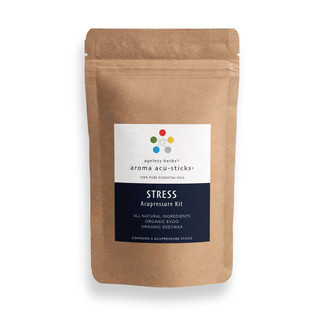
It is known that our nervous system has two functional modes; the Sympathetic and Para-sympathetic. We are supposed to live in the parasympathetic mode that promotes a "rest and digest" response and a calming of the nerves to preserve adrenal health. Unfortunately, many of us are caught up in an unhealthy loop of emotional responses to life's every day stresses putting us in the Sympathetic mode that promotes a "fight or flight" response inhibiting digestion, increasing the heart rate, constricting blood vessels, inhibiting reproduction responses, and causing our body to consume tissue for quick energy; this creates Yin Deficiency.
Stress increases your glucose needs and regulation, so meditation is another important preventative practice for wellness and pre-diabetic candidates. A regular practice of meditation and Qi Gong breathing exercises performed daily for 15 to 20 minutes will normalize the stress response and allow us to respond to life challenges with grace and flexibility. There are also herbs called adaptogens that nourish our nervous system and allow us to adapt to change and unexpected disruptions to everyday life.
Lifestyle Practices that Help Balance Blood Sugar
Diet and Blood Sugar
Recent studies have shown that more than 90% of diabetes-type 2 is avoidable through lifestyle changes, not drugs and surgeries! Chinese food therapy and herbal therapy is a great example of a positive lifestyle change that can help to prevent a person who is diagnosed with pre-diabetes.
15 to 30 % of people with pre-diabetes will develop diabetes within 5 years!
The fact that increased rates of diabetes in the U.S. and other countries mirror the increased rates of obesity is certainly not a mere coincidence, but there certainly has been an overemphasis on weight rather than wellness in relations to diabetes prevention. Foods that are fatty or fried, sugars, and refined foods damage the Spleen according to TCM. With the Spleen system impaired, foods are not utilized properly and weight gain persists regardless of dieting efforts, or weight loss can occur as the body does not take nourishment in correctly.
Consuming whole foods is vital in the prevention and successful reversal of this condition. Sugars and white flour, rice, or potatoes should be replaced with whole grains; fruit juices should be replaced with whole fruit sparingly; and vegetables should consumed with wild abandon. Protein consumption is vital in maintaining level blood sugar levels and is best obtained through nuts, eggs, beans or legumes, and fish; keep meat and cheese, and greasy food consumption to a minimum. Most importantly, avoid iced drinks, raw foods, and frozen foods that can damage the Spleen according to Chinese medicine.
Sugar Substitutes
In an effort to cut calories, overweight people will consume beverages with sugar substitutes. This strategy backfires as the pancreas is stimulated to release insulin without the presence of glucose in the blood stream. The individual cells respond by removing receptor sites for insulin. When the body does consume food, the cells are unable to uptake much of the resulting glucose because of the reduced number of insulin receptors and the glucose circulates to the liver where it is stored as fat. Additionally, sugar substitutes tend to be much, much sweeter than real sugar and create a craving for very sweet substances.
Exercise to Balance Blood Sugar
Moderate exercise has proven to be invaluable with all types of chronic disease patterns. Additionally, regular exercise reduces stress that can contribute to the development of diabetes. A brisk two mile walk daily is preferred over running in this condition and Tai Qi and yoga are helpful in building Qi. The cells are responsible for many actions including making available energy for us. As the cells become less productive because of the developing insulin resistance there is less energy for exercise, and the condition just continues to spiral out of control. Moderate aerobic exercise is vital in maintaining proper blood circulation in this debilitating disease.
Historical Perspective of Chinese Medicine and Blood Sugar
Acupuncture has been used to treat diabetes for over 2000 years. A patient with 'Xiao Ke' or 'wasting and thirsting disease' (the Traditional Chinese Medical term for diabetes) is discussed in detail in the Nei Jing, a classic Chinese Medical book written about 2,500 years ago. The patient is described as having symptoms of excessive hunger and thirst, frequent urination and rapid weight loss; all symptoms of diabetes.
According to Traditional Chinese medicine, diabetes is caused by an imbalance of the cyclical flow of Qi within the meridians and organ systems. This particular imbalance produces heat that depletes the body's fluids and Qi causing symptoms such as:
- fatigue
- lethargy
- unexplained weight loss
- excessive thirst (polydipsia)
- excessive urination (polyuria)
- excessive eating (polyphagia)
- poor wound healing
- infections
- irritability
- blurry vision
There is historical data showing that Chinese medicine has recognized and treated blood sugar imbalances for over 2,000 years. The big difference during modern times is that we see more of an emphasis on Spleen Qi Deficiency due to poor dietary habits rather than Kidney Yin Deficiency. There are many patterns of imbalance that are possibly present, but there are some basic commonalities in the majority of diabetes cases according to Chinese medicine. There are typically three stages in type 2 diabetes described in ancient Chinese texts. Each individual will advance through diabetes differently, but this is a basic progression common in type 2 diabetes:
Stage 1 of Wasting and Thirsting Syndrome in Classical Chinese Medicine
Before diabetic symptoms appear, there are signs of Yin Deficiency. Thirst is a common sign of Yin Deficiency and is prevalent in patients with diabetes. Unfortunately, simply drinking water will not reverse Kidney Yin Deficiency, as the condition requires Yin nourishing herbs. Yin Deficiency can also present with afternoon or night sweats, hot flashes, and symptoms that worsen at night.
Stage 2 of Wasting and Thirsting Syndrome in Classical Chinese Medicine
As the disease progresses, Yin Deficiency left untreated persists, and Qi Deficiency develops next. The pancreas is part of the Spleen energetic organ system in Chinese medicine; Spleen Qi Deficiency is common in the pre-diabetes stage and throughout the disease pattern. The Spleen is responsible for the way we utilize and store food in Chinese medicine; obesity, thinness, nausea, and digestive issues are all indications of Spleen imbalances.
Stage 3 of Wasting and Thirsting Syndrome in Classical Chinese Medicine
Yang (energy) is dependent on Yin (substance) and Qi (energy); if diabetes progresses without proper treatment, all three will collapse. Blood is dependent on Qi to circulate, so further symptoms develop related to poor circulation such as neuropathy and pain. Look to Blood Mansion formula for improved circulation. At this stage, the diabetes is an advanced disease and becomes difficult to reverse.
Aroma Acu-therapy can assist the body to regain its' normal healthy function of blood sugar regulation, but you should maintain realistic expectations. Pre-diabetic conditions can often be fully reversed, while type 2 diabetics have a chance of reversing their condition when caught early on. This outcome is only seen with great effort over many months of Chinese medical therapy and healthy lifestyle practices; it is a serious commitment. Those who have chronic type 2 diabetes or type 1 diabetes can find that acupressure, food therapy, and herbs used consistently can help to moderate blood sugar levels and help to provide an improved quality of life; while not a cure, balancing blood sugar helps to reduce cellular damage caused by blood sugar fluctuation.
Natural treatments can provide substantial results in addressing blood sugar imbalances, but it is helpful to have realistic expectations in treating blood sugar imbalances with acupressure, food therapy. In order to manage this condition naturally, it is essential for people with diabetes to make healthy lifestyle choices in diet, exercise, and other health habits. Additionally, acupressure is effective in addressing nerve pain due to advanced diabetes.
Liao WT, Su CC, Lee MT, et al. Integrative Chinese herbal medicine therapy reduced the risk of type 2 diabetes mellitus in patients with polycystic ovary syndrome: A nationwide matched cohort study. J Ethnopharmacol. 2019;243:112091. doi:10.1016/j.jep.2019.112091
Wang J, Ma Q, Li Y, et al. Research progress on Traditional Chinese Medicine syndromes of diabetes mellitus. Biomed Pharmacother. 2020;121:109565. doi:10.1016/j.biopha.2019.109565
Zhang TT, Jiang JG. Active ingredients of traditional Chinese medicine in the treatment of diabetes and diabetic complications. Expert Opin Investig Drugs. 2012;21(11):1625‐1642. doi:10.1517/13543784.2012.713937
Putiri A. L., Close J. R., Lilly H. R., Guillaume N., Sun G.-C. Qigong exercises for the management of type 2 diabetes mellitus. Medicines. 2017;4(3):p. 59. doi: 10.3390/medicines4030059
Liang H.-Y., Hou F., Ding Y.-L., et al. Clinical evaluation of the antioxidant activity of astragalus in women with gestational diabetes. Nan Fang Yi Ke Da Xue Xue Bao. 2009;29(7):1402–1404.
Büyükbalci A., El S. N. Determination of in vitro antidiabetic effects, antioxidant activities and phenol contents of some herbal teas. Plant Foods for Human Nutrition. 2008;63(1):27–33.
This information has not been evaluated by the Food and Drug Administration. This information is not intended to diagnose, treat, cure, or prevent any disease.